Showing posts with label Chattering. Show all posts

Tuesday, April 15, 2008

Apparently praising the aesthetic qualities of a battleship is some kind of warmongering.

Y'see, calling an instrument of death beautiful is wrong, at least in the eyes of some Catholics who are qualified to judge morality.


Now, they do have a point. After all, no matter how shiny a garbage truck is, it's still used for carting garbage around - and no matter how beautiful a war machine is, it's designed for killing people, many of whom land in Hell as a result. And a lot of people (most notably those in France, Germany, and the areas between) praised the beauty of their weapons to hide the fact that they were growing too warlike (to use a mild phrase)...


Then again, praising the looks of this weapon...


...doesn't mean you approve of how Francis Macomber died in Hemingway's story.

Monday, April 7, 2008

In Keeping with my tradition of not having anything to do with important cultural issues...

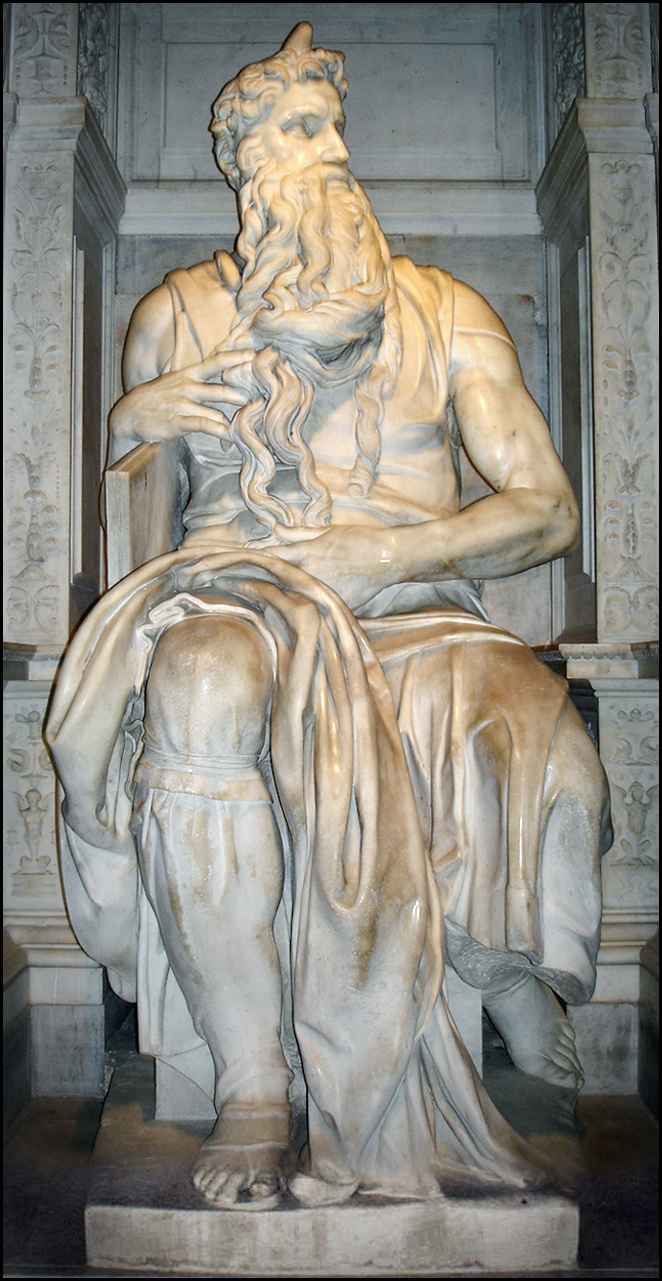
I present to you this question: Did Moses have horns? (I don't know what Daniel Mitsui's authority on this matter is, other than that he's at least a well-informed amateur student of religious art, and sells his own religious art.)

On the one hand, you'd expect someone who spoke with God to shine, not sprout horns. On the other hand, not all horned creatures are evil - unicorns, for instance. (I'd argue that, if Moses had horns, it would refer to the ram which God sent to Abraham, since both were God-given gifts which prevented the Chosen Race from getting exterminated.)

Of course, it doesn't help matters that this statue of Moses makes him look like Zeus in the process of having Athena pop out of his head..

Tuesday, November 13, 2007

While dredging the Web, I found this:


"There's no energy on the non-zealot side of the cultural debate."


Some quotes - like this one - are just too exquisite to pass by. And so, taking a page out of G. K. Chesterton's book Tremendous Trifles, I will attempt to parody its style.


  • There's a disappointing lack of Republicanism in the Democratic Party nowadays.


  • Unfortunately, there's little sympathy for OU's football team among UT fans.


  • Surfers, oddly enough, don't like to live in Nebraska.


  • Saladin didn't actively support Richard the Lionheart's cause.


  • Fish adamantly refuse to take part in marathons, despite a major publicity campaign aimed at getting "FINS ON THE ROAD!"


In more current news...

The Pope, for some reason, is "bypassing" Boston in his upcoming visit - point of fact, he's only going to New York and Washington, D.C. This, I suppose, proves beyond a doubt that Boston is now flyover country.

I think a lot of people are regretting the decision to let China have the Olympics. They're putting cell phone towers on Mount Everest, prohibiting Olympic athletes/attendees from having bibles...something tells me they'll next put a huge statue of Mao Zedong holding the Olympic Rings in Beijing. (By the way, the word "Beijing" is a blight on the eyes. Unlike "Peking" which had a tasteful clearness and lack of dots.)

In Venezuela, "reforming" a constitution apparently means creating a dictator and eliminating freedom of the press. Maybe they meant "reforming" in the sense that this is "reforming" a birthday cake.

Oh, and D.G.D. Davidson and I are doomed to MORTAL COMBAT!

On one side, the veteran of countless archaeological encounters and international Sharp Trowel Expert, on the other, a veteran of The Simplification with world-renowned prowess in blunt weaponry...

In the case of , um, this blog going dormant, I'll just say I don't much regret what I've done with my life (except the one time I used my sister's copy of Persuasion as tinder....and the time I ate Tabasco sauce straight....and some other things...)

Over and out.

Thursday, November 8, 2007

I don't have time to think tonight...

So I'll just fling some links at y'all.

From the InsideCatholic.com blog, a post on how looks matter in tasting wine. (Not in the sense of the wine having no visible grape skins in it.) A distressing line in the post: "Forty experts said [a particular wine] was worth drinking..." Now, I could say that a wine is or isn't worth buying, but isn't any unadulterated wine worth drinking?

From the same website, a column about Muslims, aesthetics, and the Blessed Sacrament.

Since our house doesn't have TV, the recent TV writers' strike hasn't affected me much- but I have read quite a bit about it. The best perspective on it that I have seen is here, on a post written before the strike actually began. I like the closing line of the post.

From Darwin Catholic, a post on the problem of evil. I have to admit, I don't really worry much about why God allows evil in the world, since from early childhood I have been taught that

1. Good things come from God, and
2. If something is bad, it's because mankind/the Devil messed it up.

My sister is preparing to resort to armed coercion to make me go to bed mow, so goodnight, everyone!

Monday, November 5, 2007

Government regulation of book price in Germany: how lovely!

The worst thing is that this, in effect, is a 60 percent tax on BOOKS, effected by means of price controls.

Mark that: BOOKS ARE BEING TAXED.

Books are the things that separate civilization from barbarism. The things that keep us from having to spear our own food and cook it over brushfires. The things that, more commonly, give us a worthwhile thing to do at the doctor's office.

And they drive up the price!

Admittedly, there's relatively few books worth buying in any case (browse any bookstore and you'll see what I mean), but those that are are being unjustly taxed.

Makes me wonder: are there laws on reselling books in Germany?

Saturday, October 20, 2007

In the paleo-future.....

Mark Shea recently wrote an article about old predictions about the future, such as those collected on a blog called Paleo-Future. (Hat tip to Sci-Fi Catholic.)Of course, most of these predictions were wildly inaccurate, although some have come true. (I think here of a Renaissance woodcut that depicted the technology of Utopia, with submarines, "light projected great distances," fire that burns on water, and plants modified to bear larger and tastier fruit.)


Since I have nothing wise or illuminating to say about that, I'll just show you an old prophecy that I came across in the book Misguided Weapons, which quotes at length one Dr. Vannevar Bush.


Dr. Vannevar Bush was head of the Office of Scientific Research and Development during World War II, which was in charge of everything American scientists did for the war effort, from the Manhattan Project to penicillin production. After the war - in September of 1949 to be exact, he wrote a book (Modern Arms and Free Men) on the nature of a future conflict. Of course, this could only refer to a confrontation with the Soviet Union, which by then had its own atomic bombs.

The most notable predictions:

  1. Future navies would operate only against enemy submarines, since they alone would be capable of strategic bombardment. Bombers, missiles, and land-based rockets would be useless because...
  2. Jet aircraft and anti-aircraft guns would make short work of any bomber before it got in range of any important target. Jets, however, would be incapable of dogfighting, since their velocity wide turning radii would leave them at the mercy of more maneuverable propeller aircraft. (Bush apparently believed that speed is a liability in a fighter aircraft.)
  3. As for missiles, their predictable flight paths would make them easy to shoot down.
  4. Rockets (i.e. ballistic missiles) would have a practical range of only 400 miles, and therefore only submarine-mounted rockets would be threats to the U.S. homeland.
  5. Even if rockets were capable of intercontinental flight, they would be impossible to guide, and would miss their targets by hundreds of miles - making them completely useless.
  6. The limited supply of uranium would make it "quite a few years" before the U.S. and the U.S.S.R. had enough bombs to wage an all-out nuclear war. (In 1951, the USSR had 25 bombs, while the U.S. had 438, 268 of which had been built after the Soviet bomb test.)
  7. No totalitarian regime would be capable of producing the sophisticated products which free countries like the U.S. were capable of. (Bush, however, does praise the Nazi-developed V-2, which required "great ingenuity and engineering skill," and which formed the basis for all subsequent rocket science.)

Now, this is the exact opposite of what Paleo-Future is about. Bush is prophesying that various forms of technology would not be used in the future: by 1959 all of his predictions were proved wrong. So spectacularly wrong, in fact, that the author of Misguided Weapons conjectures that Bush was deliberately making false predictions in order to confuse the Soviets. However, Bush may have in fact believed everything he said, in which case a scientist, with access to the most up-to-date information on military technology, and years of experience in military research, was flat-out wrong about everything he expressed an opinion on.

I think you know what that implies.

Wednesday, September 19, 2007

The three-step status reduction system:

1. Kill lots of people.
2. Deflect the blame and punishment to other people/things.
3. Become loathed.

Tuesday, September 18, 2007

The gist of it: two people meet each other online, complain about their lousy marriages, fall in love, then discover they're married to each other.

The most remarkable quote is:

Adnan, 32, said: "I still find it hard to believe that Sweetie, who wrote such
wonderful things, is actually the same woman I married and who has not said a
nice word to me for years."


Technically speaking, she has been saying these nice words to you for years.

If it weren't for the fact that this all is ending in a divorce, I would find the whole incident extremely funny.

Tuesday, September 11, 2007

Uh...wasn't religion here the whole time?

Here's my fisk of the whole thing.

Globalization is turning out to be both a curse and a blessing:

How ironic that you say on the anniversary of September 11th.

During times of limitless communication, everything seems possible -- but nothing is stable. Whether they want to or not, people are swept away by the current of change.

I learned that when I was 15. Or maybe even earlier.

The search for orientation in this world is immense and many people look to religion for support and answers.

Bah humbug. I knew that when I was seven.
Seriously, the reason folks look to religion for support and answers is that religion is the only thing that gives us answers to certain questions, such as "What must I do to be happy?"

Be it the pope, who is celebrated like a pop star in the West,

BXVI is my homie!

or Islamist groups that are finding more followers in the Arab world,

Come ON! Tell us something about the Islamist groups other than that they're growing - we already knew that!

religion is once again an issue.

This is where knowing history would help.
Religion was an issue during the 1980's (see "Poland," "Iran,") and during the Vietnam War (see "Buddhist-Catholic Relations in Vietnam"),to name only two examples.

It gives them spiritual strength.

Undefined pronouns - "it" may be "religion" or "an issue," and "them" refers to a plural verb approximately four clauses away.


But religion is also a power that feeds conflicts and is abused for political interests.

I can name two other powers that feed conflicts and are abused for political interests. (Hint: one has to do with economics, the other with biology.)

What does this return to religion mean in times of globalization?

It means you won't be able to ignore the fact that the vast majority of the world has religious beliefs.

In features, interviews and analyses, Deutsche Welle tries to find answers in this dossier. Please click on the links below to join the search.

"Deutsche Welle tries to find answers....join the search." Sounds like Deutsche Welle is a character from a police drama.

What (you might wonder) possesses me to post this on the sixth anniversary of September 11th?

Well, because the attacks were motivated by religion (specifically, Islam - although a long-suppressed grudge against the West had a great deal to do with it as well). And, if this article means anything, it means that the editors of DW know little about religion, and therefore can hardly be much help in explaining what we have to do to prevent this from happening again.

At least they didn't ask us to convert to Islam. And they didn't use the word "Inquisition," to the great delight of the Sucrose Inquisition.

Sunday, September 9, 2007

This is why I need to study economics.

So we expand the Panama Canal and....it changes the economic setup of my hometown, Dallas?

Strikes me as bizarre, but I suppose it all makes sense...

Thursday, September 6, 2007

"Part of the trick, too, is recognizing the continuities between pagan and modern habits and learning to call them by their traditional names."

An interesting post on First Things about (as the quote implies) the similarities between modern and pagan culture.

Here's a few modern habits with traditional names:

Consulting a psychic - Consulting the oracle.
Reading one's horoscope - taking the auspices.

Come up with more.

Thursday, June 28, 2007

Reflection on languages

As some of you may know, I study Latin. I'm not that good at it, but study Latin I do. Anyway, the language is complex - each noun has five (occasionally six) declension, each verb has about 36 different forms, and so forth.


Latin is very elaborate. As a result, it is worse (in certain respects) than modern English. English is not as hard to learn, and can easily absorb technical and foreign words. Over time, Latin degenerated into more handy, convenient versions such as French and Spanish, which are approximately as complex as English. Language thus has evolved from complex to simple, rather than the other way around.
Then again, Latin is rather simple. It gives each word the fewest number of meanings possible - "domi," for instance, only means "at home" - and has standard rules for every situation. In contrast, the English language uses a bunch of prepositions and very few suffixes, making it necessary to guess a word's meaning from the context of the sentence it is in. (For instance, the "it" I just used. Is "it" a word, a meaning, a guess, a necessity? You have to figure out.)
So Latin is more complex than English, since there are so many rules, but more simple, since those rules are more universally applied. What practical use this can be put to, I leave to someone with more time.

Thursday, June 7, 2007

Hup, slow news night all right!

I am starting to agree with those who say newspapers are declining.

Friday, May 11, 2007

"Religion guided three held in Fort Dix Plot"

I guess the others were just in for the ride?

Seriously, the NYT mind as well hear this: in a totally unfamiliar culture half a planet away, many Muslims find the teaching that Christian society must die to be an excellent application of Islam. Perhaps they're wrong to think so, but WHO CARES? They're our enemies by choice.

And: who would say "Religion guided many Inquisitors in persecution of Spanish conversos plot?"

Wednesday, May 9, 2007

Yeah, this job's hard all right...

difficult to overcome your humanity when you do this work.

I noted:

not every one could do what we do.

It isn't a compliment. Not everyone can be a hitman, if you think of it.

Tuesday, May 8, 2007

Unfortunately, our enemies are not, as a rule, this dumb

Fortunately, they are this stuck-up.

-

I'm waiting for someone to look at the Middle East and decide "Hey, when do we get to stop recieving attacks from the Imperialist/Jewish/Crusader forces and maybe conquer something?"

-

It will be a while, but eventually it will come, I am certain...

Monday, May 7, 2007

Impartiality, Atheism, and the Intellect

Nick Milne asks: why are religious debates always "Pinky Vs. The Brain" - like matchups?

Note one key line in his post:

"The trend in question is that of media institutions sponsoring "debates" on religious matters..."

Note the "media." It is pretty well-known that newsmen tend to be leftist, as do atheists. It is also well-known that human nature makes us slant the field - as far as possible - in favor of our side. And if only one group is sponsoring a debate, they can easily invite only those whom they expect will work well. Not very virtuous, but it happens.

Then again, most influential religious personages in America just aren't all that smart to begin with. Primarily because they usually are 'better living through theological fast food' types. Not to say that all American religious leaders are dumb, or that all the dumb ones are Protestants. But American Protestantism isn't known for encouraging heavy reliance on reason. Catholicism, I would say, is a better choice for the born sophist (me!) to protect him from himself.

This is where I'm glad of our current Pope - theology is not an easy intellectual pursuit, even if you don't believe it, and his ponderings are definitely high-grade. Closer to home, I'm not so confident. I can't name a bishop with the rhetorical smarts to out-talk Hitchens.

But I hope those bishops use the excuse: "Oh, I'd happily debate, but I'm too busy doing God's work and keeping my diocese from going belly-up."

As to the existence of God.........well, Voltaire was right when he said we'd have to invent a God if He didn't exist. Our nature is to believe in God - at least some overarching authority to which all men (theoretically) must yield, which dominates the universe - and the universality of religion proves it (almost the whole world's population believes in a God, and intellectuals are generally split on this). The only real question is to find what sort of God exists, and what He wants. That, at least, is my theory.

As an aside, if I thought God didn't exist, life would be hell within my neighborhood (until I got shot, that is). Hitchens is probably a more virtuous man than I, seeing as he's not been shot yet.

Friday, May 4, 2007

The Kent State Massacre occurred today in 1970.

It is unique to America that it calls relatively small shootings (compared to those in most of the world) massacres.

Not a bad thing, but odd.

Too true, too true.

This is why big families are a good thing.

Consider that the Bible rarely fails to mention "abundant descendants" as God's blessing to the just.

Tuesday, May 1, 2007

"We want people of faith, but we don't want them making decisions based on their faith."

Somebody is in deep denial.

A Marxist will make decisions based on his Marxism, even on things unrelated to Marxism; he might not wear tennis shoes because capitalists made them.

An animist will also make decisions based on animism, but unrelated to animism, like not eating 'sacred' animals.

And Christians - specificially Catholics in this instance, but "people of faith" always refers to Christians - will make decisions based on Christianity that are unrelated to Christianity per se, like not voting for abortion.

SEARCH ME, I DUNNO!

Google
WWW http://est-puzzlementem.blogspot.com
Powered By Blogger